Quality is now the single biggest factor driving pet product purchases in the UK, with trust and knowledgeable service close behind, according to a major new survey commissioned by Johnson’s Veterinary Products, which has manufactured pet healthcare products since 1921.
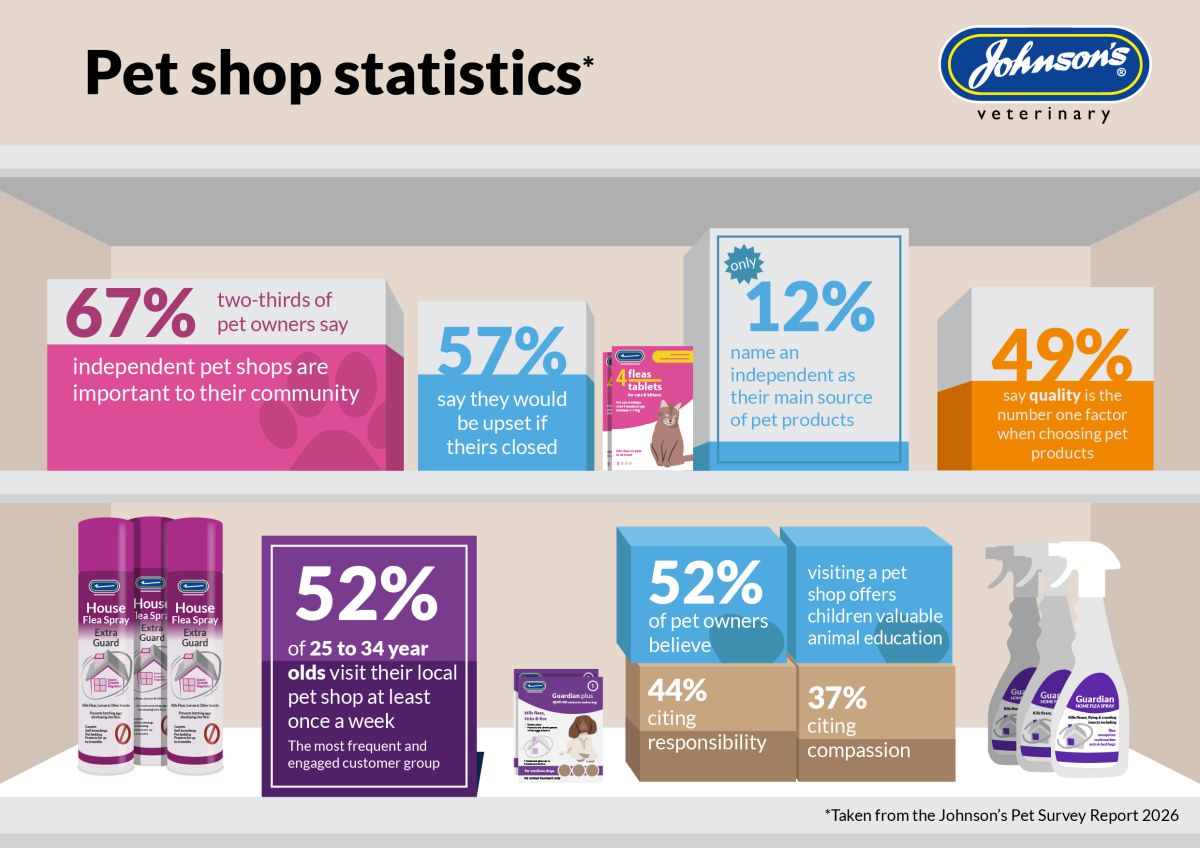
The Pet Owner Survey Report 2026, the second in a series tracking the habits and attitudes of UK pet owners, found that 49% of respondents cited quality as the leading influence on their purchasing decisions, with cost on 45%. Trust also proved to be an important factor at 39%, highlighting the importance pet owners place on buying from sources they have confidence in.
Paul Gwynn, Chairman of Johnson’s Veterinary Products, said: “Our job is to make products that work. The independent pet shop’s job is to put those products into the hands of customers who trust them. This survey tells us that pet owners value both: they want quality products that offer value for money, and they want to buy them from people who understand their pets.
“Two-thirds of pet owners told us that independent pet shops are important to their community. Nearly six in ten would pay slightly more at a local shop to support the high street. That kind of loyalty is not something you can manufacture. It is earned through knowledgeable service, good advice, and being there when a customer needs help.
“We produce this research for the benefit of the whole trade. The better we understand what drives pet owners, the better we can support the retailers who serve them. That has always been what Johnson’s is about.”
The survey of UK pet owners, conducted by Censuswide in February 2026, also found that 71% always or often read product packaging before treating their pet, confirming the value of clear labelling and staff who able to offer advice about products.
When asked which environmental factors influence their purchasing, ingredients topped the list (38%), followed by whether a product is natural (35%) and its cruelty-free credentials (30%). British manufacturing was cited by 26%, and packaging materials by 23%.
The 25 to 34 age group emerged as the most engaged customers of independent pet shops, with 52% visiting at least once a week. They also expressed the strongest emotional connection to their local shop, with 70% saying they would be upset if it closed. However, this generation is also feeling the pressure of the cost of living, with 55% having switched products for affordability in the past year, underscoring the importance of stocking ranges that offer genuine value. When asked whether they had switched pet products for affordability in the past 12 months, 42% overall agreed.
The emotional bond between owners and their pets remains strong, with 58% saying they care more about their pet’s wellbeing than their own, consistent with 59% recorded in the last report, published in 2023. More than half (52%) believe that visiting a pet shop offers children valuable animal education, and 44% say it teaches responsibility.
A new question for 2026 explored how frequently pet owners turn to social media platforms or AI tools for pet and product information. Overall, 29% use these channels always or often, rising to 54% among 25 to 34 year olds and 47% among 18 to 24 year olds.
For independent retailers, this is not a threat but an insight. Pet owners are actively seeking information through digital channels, and much of what they find is unverified. A pet shop that positions itself as a credible, knowledgeable voice, whether through helpful social media content, short video guides, or simply by being the place customers turn to after seeing something online, can bridge the gap between digital curiosity and trusted in-store advice.
Among the over-55s, 57% said they never use social media or AI for pet information, reinforcing that face-to-face guidance remains the primary channel for this demographic. No single approach will suit every customer. The shops that thrive will be those that offer expertise both over the counter and on the screen.
Those aged 25 to 34 remain the most likely to research online before making a decision (41%), which presents an opportunity for pet shops with a digital presence. A well maintained website, active social media, and positive Google reviews can capture this research-first audience and draw them into the shop.
The report emphasised that the 25 to 34 demographic is a critical group for the independent pet trade: digitally active, emotionally engaged, and already visiting more frequently than any other age group.